
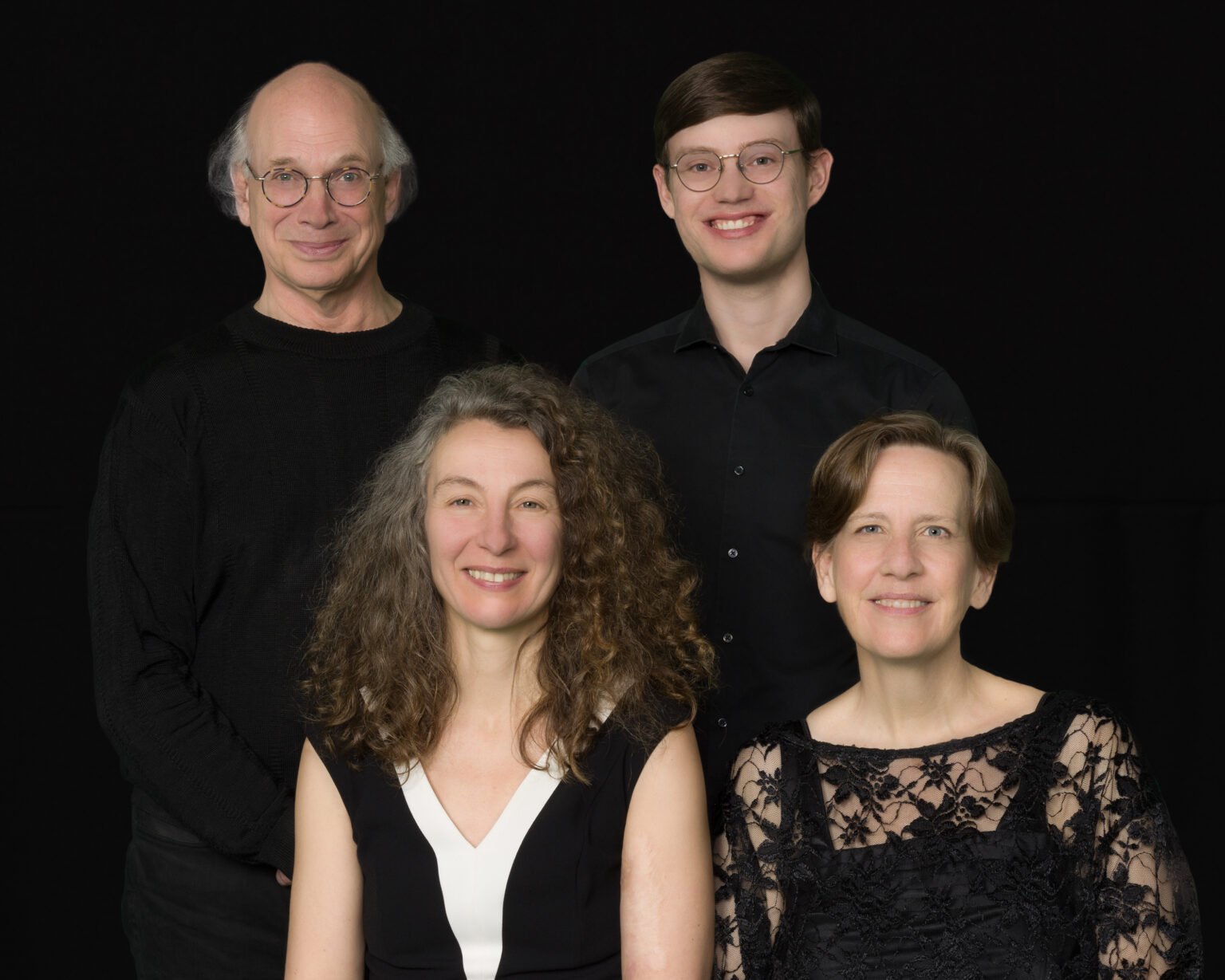
Photo courtesy of the musicians. Left to right: Myles Jordan, cello, Philipp Elssner, violin, Lydia Forbes, violin & Kristen Monke, viola
Not long after forming in Philadelphia 33 years ago, the DaPonte String Quartet surprised the musical world by moving from a cosmopolitan urban area to rural Maine. The DSQ had been — and continues to be — sought after to perform and teach all over the U.S. and around the world. They have appeared in France, Scotland, Canada, and more than twenty American states. Their performances have been broadcast over nation-wide radio and television programs in both the United States and Canada. They have received awards from the National Endowment for the Arts, the Philadelphia Musical Fund Society, the Music Teachers National Association, Chamber Music America, and have participated in several of the nation’s most prestigious concert series to rave reviews. Musicians and critics alike wondered, why would the DSQ move to Maine, where, as the New York Times noted, they create an experience “like watching the Celtics play in the local gym.”
But the members of the DaPonte String Quartet were proud to call Maine home, and their relationship with mid-coast Maine remains a deeply rooted one. When CBS Sunday Morning nationally televised a profile of the group, the idea of living outside a major urban center suddenly appeared to be an appealing alternative lifestyle few musicians had considered. Few string quartets can boast such a devoted following. The people of Maine warmly embraced the DSQ, which has become an integral part of the state’s musical life. When the Quartet debuted at Carnegie Hall, a large contingent of their fans traveled to New York to hear and cheer them there. The Times wrote in amazement: “Let it not be said that the DaPonte String Quartet enters New York musical life without friends. Weill Hall was packed!” The state’s embrace of the DSQ has also taken the form of awards from the Maine Arts Commission.
This support enables the DSQ to perform a wide-ranging and varied repertoire. While many classical musicians struggling with the realities of the contemporary musical marketplace find themselves performing exclusively new compositions, the Quartet’s repertoire spans the entire history of music, from seventeenth-century works on original instruments to cutting-edge contemporary quartets, like the one written for them by Pulitzer Prize-winning composer David Del Tredici.
The DSQ is also known for their inventive interpretations of the works they play. The Boston Globe observed that whatever music they present — be it Renaissance, Baroque, Classical, Romantic, Modern, or Post-Modern — the freshness of the DSQ’s performances make these works appear novel and contemporary: “Once again, the music could have been hot off the presses.” Their performances affirm chamber music as a vital and alive art form.
Fresh conception requires original thought, and the DSQ’s is based on solid research, extensive scholarship, and meticulous preparation. Strings Magazine recently remarked on the inclusion of British composer Thomas Ades’s quartet Arcadiana in the DSQ’s repertoire, noting that few groups would find themselves able to invest the hundreds of hours of preparation required for music of such complexity. This sort of groundwork gives their performances authority, but an authority that isn’t stiff or aloof. Their concerts are dynamic and their stage manner — with one another and with their audiences — is warm and conversational. The Quartet members regularly share musical insights with their audiences before playing and these “spoken program notes” enable the listener to enter into a deeper connection with the music.
The DaPonte String Quartet is now in season 34 and its members are still proud to call Maine home.
PHILIPP ELSSNER, VIOLIN: German-American violinist, violist, and music theorist Philipp Elssner is currently based in Northport, Maine. Philipp received his bachelor’s degree in 2021 from the Cleveland Institute of Music (CIM), where he studied violin with Jaime Laredo and Jan Sloman. In 2024 he received his master’s degree in music theory from McGill University in Montreal, where he also studied violin with Jinjoo Cho. Philipp has recently been appointed as the new violinist of the DaPonte String Quartet, a celebrated Maine-based group that has made appearances across the United States and around the world. He will begin performing with the group in June of 2024. Other recent engagements include sold-out concerts in Bayside, Maine and Ann Arbor, Michigan as a member of the Lake Trio. The trio’s 2024 schedule will include performances in North Carolina, Michigan, and Maine.
In 2017, Philipp won the North Carolina American String Teacher’s Association competition, as well as being a finalist at the North Carolina Symphony Concerto Competition. Philipp has played in master classes for renowned artists and pedagogues such as Enrico Pace, Sung-Won Yang, Paul Kantor, and Soovin Kim, as well as for members of the Emerson and Pacifica string quartets, among others. He has performed at summer festivals including Encore Chamber Music and Bowdoin International Music Festival.
As an academic, Philipp has presented research on classical and popular music at national and international conferences, including at the Society for Music Theory’s 2022 and 2023 annual meetings. His master’s thesis, “Groove in the Mix: Spatial Manipulation in Groove-Based Popular Music, 1970–Present,” focuses on the embodied effects of stereo mixing practices in funk, soul, disco, and Hip Hop.
As an educator, Philipp has taught music theory and musicianship courses at McGill University, as well as serving as a Teaching Assistant for many more music theory courses at McGill and CIM. He has also taught violin and music theory privately to students of varying levels. Philipp believes that music is an art form everyone should be able to take part in, and seeks to nurture the unique musical voices of his students.
Philipp also has many years of performance experience as a violist. Recently, this has included performances of Saint-Saëns’s Piano Quartet, Op. 41, Dohnányi’s Serenade for string trio, and Schönberg’s Verklärte Nacht in Montreal, Canada.
LYDIA FORBES, VIOLIN: Lydia traces her primary musical influences to the moment when she heard the sound of her sister’s violin—and knew it would always be time to know more about it—and to several of her teachers: Marylou Speaker, Eugene Lehner, Ben Zander, Dorothy Delay, Denes Zsigmondy, Masuko Ushioda, Jaap Schroeder, Isaac Stern, and Vera Beths.
Musical awards include the Weckstrom Prize in Musical Performance from Yale University and the Tera de Marez Oyens Prize in the Netherlands. Lydia has appeared as soloist at the Banff School of Fine Arts in Canada where she was Artist in Residence, with the Slovak Radio Symphony Orchestra, and with the Northwest Sinfonietta in the U.S.; chamber music festivals include Tanglewood, Bravo Colorado, the Portland Chamber Music Festival, Encounters with Isaac Stern in Cologne, and many others. Lydia studied with members of the Orion Quartet, the Juilliard Quartet in New York, and the Alban Berg Quartet in Vienna.
During her life in the Netherlands, which began with a Beebe Fund Grant, Lydia performed and toured with Het Zephyr Kwartet, a string quartet devoted to contemporary music and which she co-founded, Het Schönberg Ensemble, Ensemble Explorations and I Fiamminghi in Belgium, the Oslo Philharmonic in Norway, and the Netherlands Wind Ensemble, Nieuw Sinfonietta Amsterdam, the Osiris Trio, and L’Archibudelli in the Netherlands. Her travels with music have lead her to venues across the U.S. and Europe, as well as to the Philippines, Tasmania, Australia, and New Zealand. Recordings include the Sony Classical and Harmonia Mundi labels.
Lydia has performed as part of the DaPonte String Quartet since 2005; having the dream of being a member of a string quartet since age 11, she is grateful to be living this dream and bringing up her three sons in the beauties of the Maine landscape.
MYLES JORDAN, CELLO: Cellist, writer and teacher Myles Jordan arrived in the US from Canada in 1981. After completing undergraduate studies at the University of Toronto, he earned two further degrees at Juilliard, a doctorate of musical arts from Temple University, became associate principal cellist of the Concerto Soloists Chamber Orchestra of Philadelphia, then founded the DaPonte String Quartet. With over four decades’ professional experience, Myles has taught at Temple University, Wilkes University and the University of North Texas, recorded for RCA Red Seal, CBC, Cadenza and Centaur records, written for Strad Magazine and collaborated in chamber music concerts and broadcasts with several of the world’s finest musicians.
“Because music is a language, the driving impetus behind our work is to create greater awareness of historical, social, political and philosophical contexts in which it’s created. My own aim is to draw as many human connections as possible between contemporary audiences and great composers.”
KIRSTEN MONKE, VIOLA: Kirsten has performed throughout Europe, across the United States, Japan and Costa Rica. She joined the DaPonte String Quartet in 2008, a serendipitous occurrence that brought her back to her beloved home state of Maine. After completion of a BM and MM at Indiana University under the guidance of Georges Janzer of the Vegh Quartet, Kim Kashkashian and Csaba Erdelyi, she continued her graduate studies with Heiichiro Ohyama at UC Santa Barbara. She became Principal Violist of both the Santa Barbara Symphony and the Santa Barbara Chamber Orchestra, where she played for more than a decade. As a member of the Anacapa String Quartet she was awarded several prizes, including a silver medal at the Fischoff National Chamber Music Competition. She has taught at UCSB, Westmont College and is currently on the music faculty at Bowdoin College and Bay Chamber Community Music School. She is a recipient of the 2016 Maine Artists Fellowship Award.